CASE STUDY
Case Study - I
Proactive and Resilient Enterprise IT Infrastructure for Business Continuity and Sustainability
Threat Mitigation Through Integrated Data Centres, SOCs, and Disaster Recovery Infrastructure
Client Overview:
- Industry: A key regulatory authority for managing and administering key legislatures as per the Government laws.
- Geographical Spread: More than 25 locations in the State of Maharashtra.
- Objective: Establish a robust IT infrastructure to ensure 24/7 operations, protect sensitive data, and maintain business continuity during disruptions.
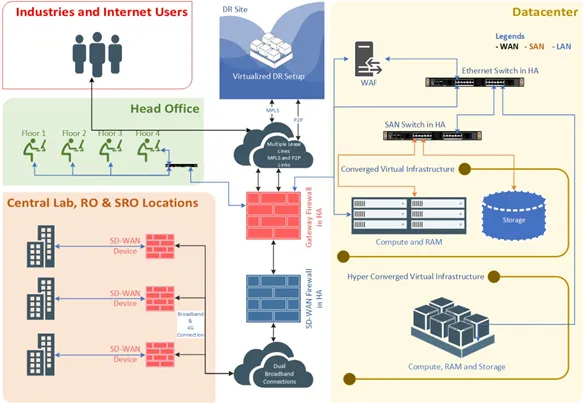
Data Centre
The Challenges:
- Legacy IT Infrastructure: Legacy systems having huge physical footprints and energy bills caused susceptibility to threats, inefficiencies, and increased downtime.
- Need for Compliance: Meeting global industry standards such as ISO 27001 to establish business credibility.
- Data Security Concerns: Increasing cyber threats such as ransomware attacks required a proactive monitoring approach.
- Limited Disaster Recovery Planning: Existing backup solutions were slow and unreliable, risking significant downtime.
- Scalability Issues: Rapid business growth outpaced the existing IT infrastructure.
- Limited Downtime Window for Migration from Legacy to Modernized Infrastructure.
The Solution
To address these challenges, the client partnered with [Your Company Name] to design and implement an integrated IT infrastructure comprising a state-of-the-art Data Centre, Security Operations Centre (SOC), and Disaster Recovery (DR) solution.
Here the Data Centre
- Design:
- On-Premise Data Centre for 99.982% uptime.
- Redundant power supplies, cooling systems with next-generation Smart Rack solutions, and Load Balanced network connectivity.
- Scalable infrastructure to support future growth.
- Deployment:
- Virtualization of servers to maximize resource utilization through Hyperconverged architecture.
- Redundant Firewalls and Load Balanced Internet gateways through two different Service Providers.
- Outcome:
- Centralized IT operations with improved efficiency and reduced operational costs.
Security Operations Centre (SOC) Deployment
- Features:
- Real-time threat monitoring using AI-driven security information and event management (SIEM) tools.
- 24/7 monitoring by certified cyber-security professionals.
- Multi-layered security protocols, including firewalls in High Availability (HA), intrusion detection/prevention systems (IDPS), and endpoint protection.
- Threat intelligence integration for proactive defense.
- Outcome:
- Reduced incident response time by 70%.
- Achieved compliance with industry standards.
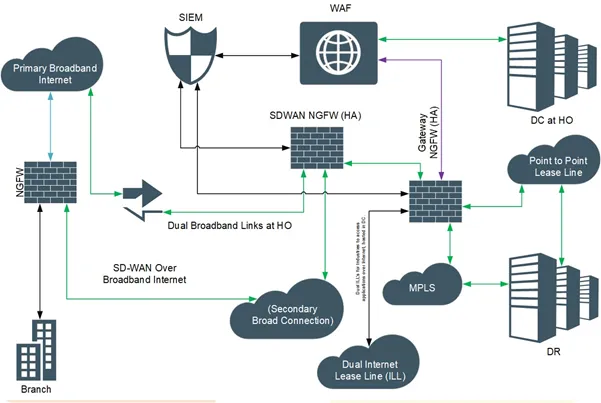
Integrated Data Centre and Disaster Recovery
Disaster Recovery (DR) Setup
- Strategy:
- Designed a DR plan with a Recovery Point Objective (RPO) of 15 minutes and a Recovery Time Objective (RTO) of 1 hour.
- Utilized cloud-based replication for real-time backups.
- Conducted regular DR drills to ensure readiness.
- Technology:
- Implemented data replication across multiple geographic locations.
- Cloud-based backup solution.
- Use of Microsoft Azure platform for Disaster Recovery with Orchestration tools for automated actions in response to disaster triggers.
- Outcome:
- Ensured infrastructure readiness with 99.99% business continuity even during unexpected (simulated) outages.
Implementation Highlights
- Stakeholder Collaboration: Engaged IT, legal, and business teams to align infrastructure with organizational goals.
- Project Timeline: Completed deployment within 4 months, including planning, execution, and testing. This was achieved through minimal downtimes during regular working hours of the office and other dependent industries.
- Change Management: Conducted training for 500+ staff on using and maintaining IT hygiene.
Results
- Improved Efficiency: Centralized IT operations reduced latency by 30%.
- Reduced Footprint and Energy Bills: Reduced the physical footprint in prime real estate by about 25% and reduced power bills by 30%.
- Enhanced Security: Detected and mitigated more than 95% of threats in real time.
- Business Continuity: Achieved uninterrupted operations.
- Inbuilt Scalability: Capacity planning to support 40% growth in operations without additional capital expenditure.
- Compliance: Successfully passed third-party audits for ISO 27001.
Key Takeaways
- Holistic Approach: Combining DC, SOC, and DR ensures a robust IT backbone for business continuity.
- Proactive Monitoring: SOC integration significantly reduces vulnerabilities and downtime.
- Future-Ready: Scalable infrastructure positions the client for future growth and challenges.
Conclusion
By partnering with Polestar Consulting, the client achieved a resilient IT infrastructure that supports 24/7 operations, ensures data security, and minimizes disruptions. This case study demonstrates the critical role of integrated IT solutions in driving business success.
Case Study - II:
Fortifying IT Infrastructure: A Case Study on Cutting-Edge IT Transformation for Government Resilience and Innovation
A Transformative IT Infrastructure Overhaul for Government Excellence through Virtualization, Security Optimization, and Resilient Data Management
Client Overview
- Client Profile: A State Government undertaking with a charter for socio economic and industrial development of urban spaces
- IT Background:Legacy IT infrastructure built over a diverse timeline therefore fostering inorganic and non-optimised growth proving to be a bottleneck for future-ready resilient and scalable infrastructure.
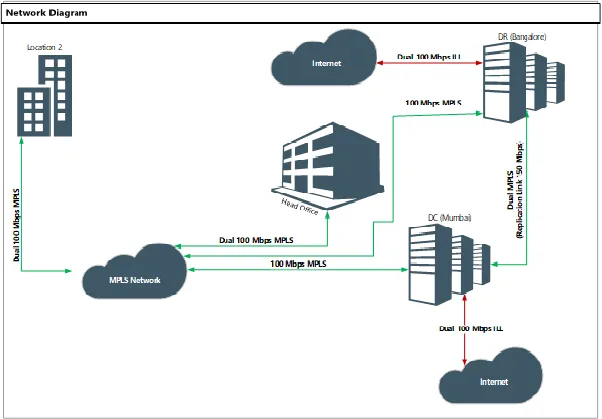
Illustration of Network Schematic
The Challenges
- Security Vulnerabilities: Protecting internet-facing applications (a mix of SAP, GIS-based, and other bespoke applications) and sensitive data from increasingly sophisticated cyber threats.
- High Availability Requirements: Maintaining 24/7 uptime for critical applications and services to ensure uninterrupted service delivery to citizens.
- Infrastructure Complexity: Managing a hybrid environment with physical and virtual servers, multiple storage systems, and a geographically dispersed infrastructure across a primary and disaster recovery site.
- Disaster Recovery Preparedness: Ensuring rapid recovery and minimal data loss in the event of a disaster.
Objectives and considerations for the Blue Print for revamped infrastructure
- Enhanced Security: A robust security framework to protect the entire IT infrastructure from cyber-attacks and data breaches.
- Continuous Monitoring: Proactive monitoring capabilities to detect and respond to security incidents in real-time.
- Optimal Performance: Optimal performance and resource utilization across all systems and applications.
- High Availability: 24/7 availability of critical services and applications for citizens and employees.
- Robust Disaster Recovery: A reliable disaster recovery plan with minimal recovery time and data loss.
The Solution:
Based on the blue print and road map of IT infrastructure a solution with various sub-systems was rolled out over a period of three years. client. The key sub-systems were as follows
- Seven Layered Security: A multi-layered security architecture was implemented,
including:
- Link Load Balancer
- Perimeter Firewalls
- DDoS Mitigation
- Application Load Balancer
- DMZ Firewall
- Email Security
- Endpoint Security
- 24/7 Security Monitoring: Dedicated Network Operations Centre (NOC) to provide continuous monitoring and incident response, ensuring timely detection and mitigation of The transformation was undertaken without disturbing the working hours and environment of the security threats.
- Infrastructure Management: Proactive management of the entire IT
infrastructure, which includes:
- 2 SAN Storages in both the primary Data Centre and the Disaster Recovery site in two physically diverse locations in two seismic zones.
- 21 Physical Servers in the Primary Data Centre and 14 in the Disaster Recovery site.
- 65 Virtual Machines (Windows and Linux) hosting production, QA, and testing environments.
- On-premise Exchange server with Application Load Balancing for high availability and optimal email delivery.
- Performance Optimization: Continuous monitoring and optimization of server resources (CPU, memory, disk space) to ensure optimal application performance and user experience.
- Disaster Recovery and Business Continuity:
- Quarterly disaster recovery drills to ensure preparedness and validate recovery procedures.
- Tape backups and offshore storage for comprehensive data protection and business continuity.
- Real-time data replication between the primary and disaster recovery sites with a 2-hour Recovery Point Objective (RPO) to minimize data loss.
Tangible Results:
- Enhanced Security Posture: The seven layers of security and continuous monitoring significantly strengthened the organization's security posture, protecting critical systems and data from cyber threats.
- Improved System Availability: Proactive monitoring and management ensured high availability of critical services, minimizing downtime and ensuring uninterrupted service delivery to citizens.
- Optimized Performance: Performance optimization measures resulted in improved application performance and user experience.
- Reliable Disaster Recovery: Regular disaster recovery drills and data replication ensured rapid recovery and minimal data loss in the event of an incident.
- Continuous Improvement: Close coordination with all stakeholders for feedback and recommendations for infrastructure enhancements and upgrades ensured the solution remained aligned with the client's evolving needs and technology advancements.
Summary
Polestar successfully delivered a comprehensive solution that addressed the Client’s critical IT challenges. By implementing a robust security framework, ensuring continuous monitoring, optimizing performance, and establishing a reliable disaster recovery plan, Polestar enabled the client to achieve its objectives of providing secure, reliable, and efficient services to its citizens. The project highlights Polestar's expertise in managing complex IT infrastructure and its commitment to delivering high-quality solutions that meet the unique needs of government organizations.